
Listen to audio:
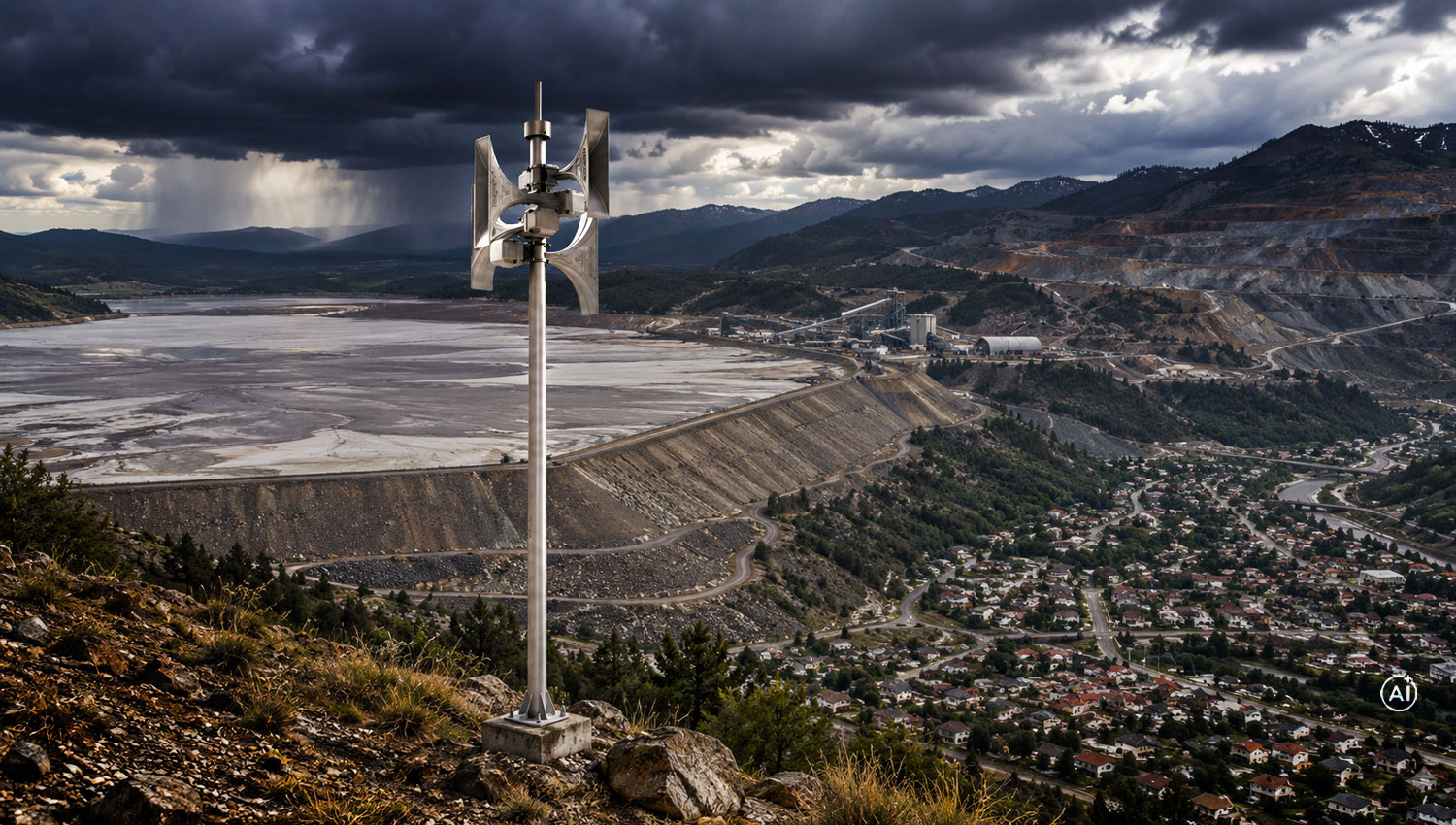
When a tailings dam fails, time is critical. Huge volumes of water and mining waste can be released into a valley within a very short period, threatening workers, surrounding communities, infrastructure and the environment. This is precisely why tailings dams are among the most critical elements of mining infrastructure.
Their purpose is to safely store material left over after ore processing. However, if a dam fails, the consequences can be rapid and devastating. Monitoring alone is not enough – information about an impending danger must reach people before the flood wave does.
Lessons from the Past, When Minutes Mattered
The history of mining shows that a tailings dam failure is not necessarily a slow process that leaves enough time to respond. In some cases, enormous quantities of material have been released almost instantly, affecting communities and workers located downstream of the dam.
One of the most tragic events was the disaster at El Cobre, Chile, in 1965. A powerful earthquake caused the collapse of tailings dams at the El Soldado copper mine. The resulting mudflow almost completely buried the village of El Cobre and killed more than 300 people. Even six decades after the disaster, it is still described in specialist literature as one of the most serious mining disasters in Chilean history.
Brazil has also experienced devastating tailings dam disasters. When the Fundão tailings dam near Mariana collapsed in 2015, 19 people were killed and approximately 39.2 million m³ of mining waste was released. The mud subsequently travelled approximately 650 kilometres through the Rio Doce river basin to the Atlantic Ocean, making it one of the most serious environmental disasters in the history of Brazilian mining.
Only four years later, the Brumadinho disaster followed. On 25 January 2019, a tailings dam at the Córrego do Feijão mine collapsed, claiming 270 lives. Brumadinho subsequently became one of the main catalysts for the development of the Global Industry Standard on Tailings Management, introduced in 2020.
In Peru, one of the country’s most tragic mining disasters occurred at Chungar in 1971. A landslide from Cerro Chungar fell into Lake Yanahuín, displacing an enormous volume of water that subsequently struck the mining camp on the opposite shore. According to Peru’s INGEMMET, approximately 400 people lost their lives. Although this was not a tailings dam failure, but rather a landslide into a lake followed by a destructive wave, the event dramatically illustrates how quickly a catastrophic scenario can develop in a mining environment and how little time may be available for warning and evacuation.
Similar disasters are not limited to Latin America. In Val di Stava, Italy, the upper tailings dam collapsed in 1985, subsequently causing the failure of a second dam. Approximately 180,000 m³ of mud travelled down the valley at speeds approaching 90 km/h. A total of 268 people were killed.
In the United States, the Buffalo Creek coal waste impoundment dam in West Virginia failed in 1972. Approximately 132 million gallons of water and coal waste were released into the narrow valley, creating a wave up to approximately 25 feet high. The disaster killed 125 people, injured at least 1,100 and left approximately 4,000 homeless.
What do these events have in common? When a tailings dam fails, detecting the danger in time is not enough. The warning must reach people at risk quickly enough to give them a real chance to respond.

From Experience to Regulation: What Does Legislation Require Today?
Past tragedies have gradually changed the way governments approach tailings dam safety. In some countries, monitoring the dam and having an emergency plan are no longer sufficient. Modern legislation increasingly addresses how the population must be warned, as well as evacuation, system testing and redundancy.
One of the clearest examples is Brazil, where tailings dam disasters have led to significantly stricter mining dam safety regulations. Federal Law No. 12,334/2010, strengthened by Law No. 14,066/2020, explicitly provides for the installation of an audible warning system as part of the emergency action plan.
The current ANM Resolution No. 95/2022 goes even further: for specified categories of dams, it requires automated siren activation, with automatic activation complementing both local manual and remote control. For selected communities within the Zona de Autossalvamento (ZAS) – the Self-Rescue Zone, where the time available for intervention by emergency services is too short – the regulation explicitly requires a “sistema sonoro ou outra solução tecnológica de maior eficácia, com redundância”, meaning an audible warning system or another more effective technological solution with redundancy.
Even more detailed requirements apply in the state of Minas Gerais. The warning system must cover all people located within the ZAS, including persons with disabilities or special needs, and the system must be redundant. Regulations also address standardisation of siren sounds and emergency messages, coordination of alarms where multiple dams are located in the same valley, regular drills, and continuous readiness for system activation.
The Brazilian approach therefore clearly demonstrates that modern tailings dam warning is no longer simply about having a siren. It requires a complete, functional and regularly tested system capable of responding within seconds and minutes.
In Peru, Supreme Decree No. 034-2023-EM amended mining safety regulations in 2023 to introduce specific requirements for tailings management. Article 419 establishes that the emergency preparedness and response plan must take into account the possibility of a tailings dam malfunction or collapse.
Based on the results of risk identification and assessment, the response protocol should include “sistemas de detección de anomalías, alertas sonoras con decibeles y sonido diferenciado” – systems for detecting anomalies and audible warnings with a defined decibel level and distinguishable sounds – together with notifying affected persons, informing the relevant authorities and carrying out evacuation. These provisions remain part of the current edition of Peru’s mining safety regulations published by MINEM in 2026.
The Peruvian regulation is particularly noteworthy because it does not merely establish a general requirement to “warn the population”, but explicitly refers to:
- audible warnings (alertas sonoras),
- a defined sound level (decibeles),
- distinguishable sounds for individual warnings (sonido diferenciado).
In Chile, the main regulation governing tailings dam safety remains Supreme Decree No. 248/2006. It requires the emergency manual to include mapping of potentially affected areas, anomaly detection systems, alerts, notification of the relevant authorities and evacuation. The regulation itself does not specify a particular warning technology; however, sirens are used in industry practice. In its guide for preparing tailings dam emergency plans, Consejo Minero mentions, for example, a “código de sirena” as one of the tools for communicating with potentially affected communities.
In Colombia, Decree 539 of 2022, which regulates safety in open-pit mining, requires safety protocols to include communication between workplaces and the external environment of the mine, including “sistemas de alarma y alerta” – alarm and warning systems. The emergency plan must also include alarm systems, standardised response procedures and at least one emergency drill per year involving workers.
Detecting the Danger Is Not Enough
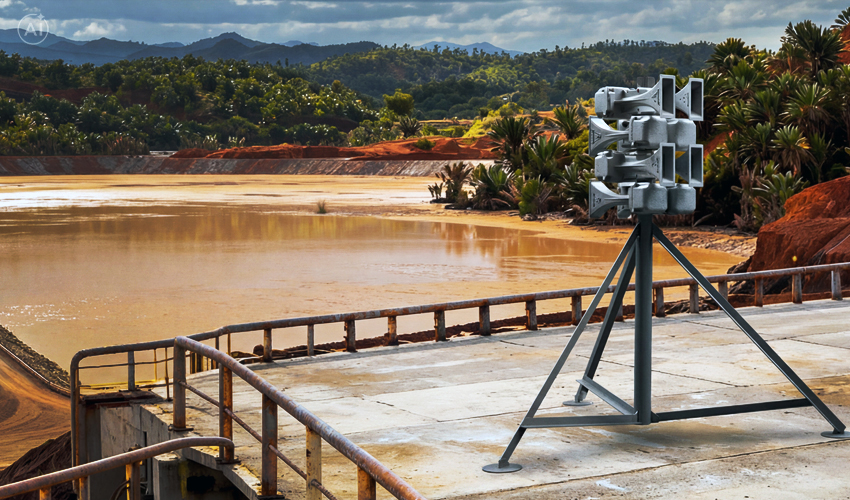
Past disasters and current regulatory developments demonstrate that monitoring the condition of a tailings dam and knowing that a problem has occurred are not enough. Warnings must reach people quickly, clearly and reliably, even if the power grid, mobile communications or one of the communication channels fails – and, most importantly, before the disaster itself reaches them.
This is why modern safety frameworks increasingly include requirements for audible warnings, redundancy, multiple activation methods, regular testing and integration of the warning system with monitoring, evacuation plans and civil protection.
FAQ
1. Why is early warning important in the event of a tailings dam failure?
If a dam fails, enormous volumes of water and mining waste can be released within a very short period. Early warning gives workers and surrounding communities valuable time to respond and evacuate to safety.
2. How can the time between detecting a danger and warning people be reduced?
By integrating tailings dam monitoring with a warning system capable of automatically activating sirens when predefined conditions are met. This reduces the time required to issue a warning and gives people at risk more time to respond and evacuate.
3. What features should a tailings dam warning system have?
It should provide sufficient coverage of the at-risk area, distinguishable audible warnings and reliable operation even during power or communication failures. Backup power, redundant communication channels, and automatic, remote and local activation options are important, depending on the assessed risks and applicable regulations.
4. Why are regular tests and evacuation drills necessary?
Tests verify the functionality and readiness of the warning system. Evacuation drills help workers and residents recognise warning signals and understand how to respond and where to go. Together, they can identify weaknesses that could delay evacuation during a real emergency.
5. Who must a tailings dam warning system reach?
Warnings must reach everyone within the potentially affected area, not only mine workers. The system design should take into account surrounding communities, remote workplaces, as well as people with disabilities or special needs, so that they can receive and understand the warning.

The article was written by
Petra Rychtarcikova
Petra is an international business manager in charge of Spanish, French and Portuguese-speaking countries. Petra, with her global, economic and logistic background and knowledge of four languages, does very productive and responsible work for Telegrafia. Latin-American affairs, travelling, tourism and electronic sirens are her hobbies, and she is pleased to bring you exciting information from the Telegrafia world.