
Listen to audio:
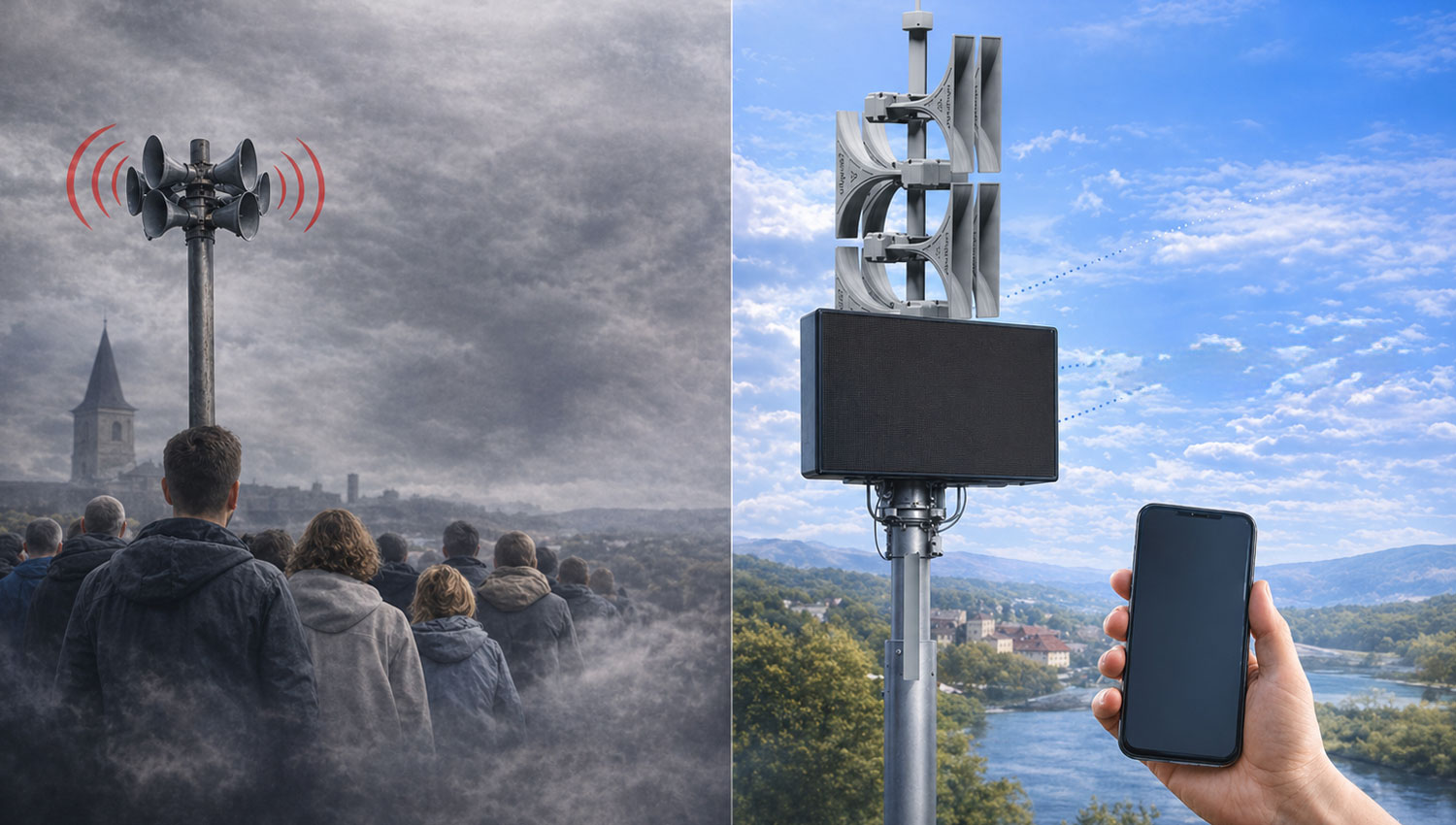
Modern warning systems have undergone significant development over the past decades. Traditional solutions, such as electromechanical sirens, were for many years the standard for basic acoustic warning. Their principle is relatively simple: a motor-driven mechanism produces a predefined sound signal intended to alert people to danger. This approach was fully sufficient in its time. However, in the context of today’s requirements for crisis management, response speed, and above all clarity of information, it is reaching its limits.
The Limitation of a Single Universal Signal
The main drawback of traditional sirens is that they provide only one universal type of information: a warning signal. Regardless of whether it is a fire, a chemical incident, an evacuation, or a system test, people always receive the same signal. The information is fast, but imprecise, unclear, and often confusing. In a crisis situation, this means that people must then seek additional information to understand what is happening and how to respond.
Warning as Clear and Understandable Communication
Modern systems take this concept much further. Warning is no longer just sound, but a comprehensive, managed, and understandable form of communication.
Instead of a single universal signal, different types of messages can be broadcast:
- voice messages
- pre-recorded messages
- live announcements
These clearly describe the situation and provide people with precise instructions. This significantly reduces uncertainty and shortens reaction time. People no longer receive just an “alert,” but clear guidance: what is happening and what they should do.
Intelligent Control Instead of Manual Activation
Another key difference lies in how the system is managed. While traditional electromechanical sirens operate mainly on a simple on/off principle, modern solutions enable scenario-based control.
In addition to the alarm itself, it is possible to coordinate:
- sirens
- voice announcements
- visual alerts
and other system components. This minimizes the need for manual intervention and reduces the risk of errors in critical moments.
Integration into Crisis Management Systems
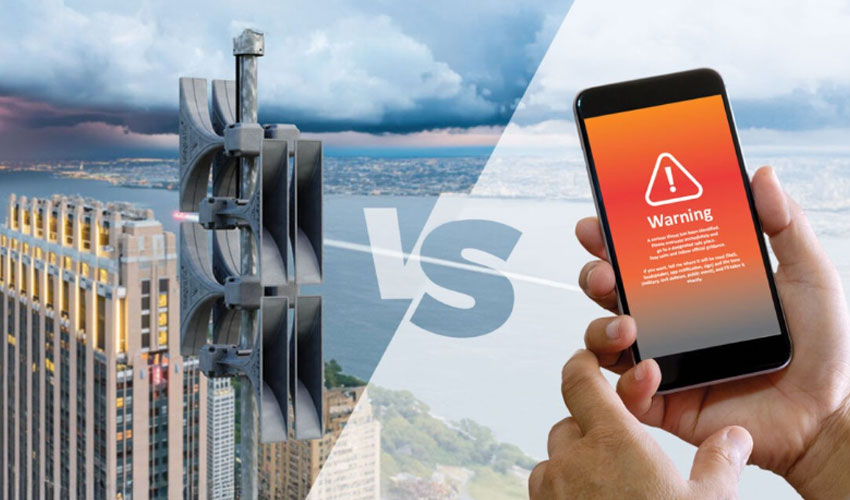
A significant shift can also be seen in integration. Older systems often function as standalone technical devices with limited connection to other infrastructures. In contrast, modern warning systems are a natural part of a broader crisis management ecosystem. They integrate with dispatch systems, SCADA, municipal and national control centers, and support a wide range of communication protocols, from IP and LTE to MODBUS and HTTP APIs. This transforms warning from an isolated function into a fully integrated part of the decision-making process.
Continuous Monitoring and System Reliability
Another key area is feedback and diagnostics. Traditional sirens offer only very limited monitoring capabilities, meaning that failures are often detected only during routine tests or, in the worst case, during a real emergency. Modern systems, on the other hand, provide continuous insight into system status from power supply and communication to the functionality of individual components. This makes it possible to prevent failures before they occur.
Energy resilience as a critical factor
Another major difference is the power supply and overall energy resilience of the system. Traditional electromechanical sirens are fully dependent on a stable external power source, the electrical grid. In the event of large-scale outages, natural disasters, or blackouts, their functionality can be significantly limited precisely when they are needed the most.
Modern warning systems address this issue through a combination of independent energy sources. In addition to grid connection, they use solar power, battery backup systems, and intelligent energy management. As a result, they can continue operating even during prolonged power outages, maintaining functionality for several days if necessary.
More Efficient Coverage with Less Noise
There is also a clear difference in how sound is distributed. Traditional sirens emit sound uniformly in all directions without the possibility of optimization, whereas intelligent systems allow for better direction and coverage planning based on urban layouts. The result is more efficient use of power and reduced noise impact outside target areas.
Scalability and Future Readiness
From a future perspective, scalability is also crucial. Traditional systems are essentially closed and offer very limited expandability. Modern platforms, by contrast, are modular and designed to evolve with new requirements, whether in terms of communication channels, analytics, or automation.
Not Just a Technological, but a Strategic Difference
From this perspective, the difference between these two approaches is not only technological, but primarily strategic. While traditional systems provide a reliable solution for basic acoustic warning, modern digital systems transform warning into a managed information process. The goal is no longer just to alert people to danger, but to ensure they quickly understand the situation and know how to respond.
In crisis management, the power of sound is no longer the key factor.
The quality of information is.

The article was written by
Barbi Martin
Barbi Martin is passionate about technical communication and innovation in early warning technologies. She loves spending time outdoors, hiking, and capturing unique moments through photography.