
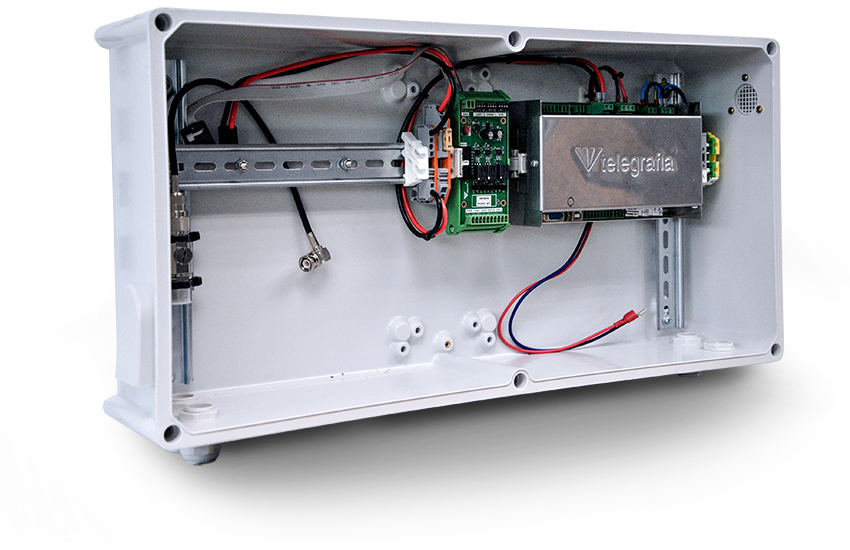
Central Communications Unit
A central communications unit is a modular communications device designed to communicate among several sirens within the siren network via radio. Commonly, it is used as a co-path that interconnects a control centre with a control unit (OCP16, LCU15 or the Vektra® software) and a wide range of integrated sirens.
CCU supports an analogue network, and it allows the connection of third-party systems to a device, whereby controlling other devices in a warning system via radio.
In Preparation
Since development is significant to our company, we are currently working on a more sophisticated CCU version called the Smart CCU. The new type of communications unit will be equipped with a computer board to provide the Ethernet connectivity for a radio modem, and unlike the previous CCU, it will process the collected data automatically, thus making the communications considerably more efficient.
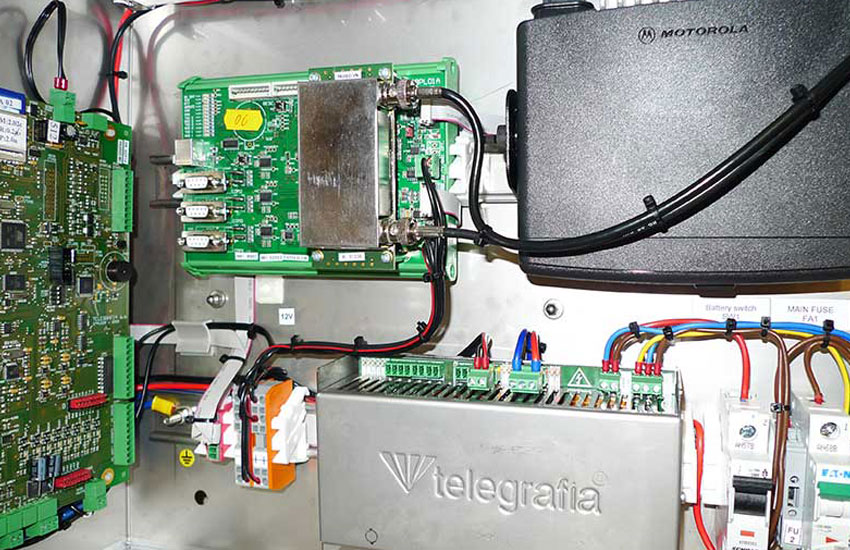
Telemetric Station
A telemetric station is also used as a co-path that connects a control centre with a control unit (OCP16, LCU15 or the Vektra® software) and a wide range of integrated sirens in warning projects; nevertheless, it offers a different range of communications channels besides the analogue radio.
This device supports communications channels such as GSM/GPRS, WIFI, XBee®, digital radio and the Ethernet, while also offering a possibility of data transmission from monitoring devices (for example, monitoring the presence of harmful substances, meteorological data, seismicity, radioactivity and the like). The monitoring is carried out using different types of sensors and detectors connected to the system via analogue or binary inputs. Subsequently, the data collected is sent to a control centre for further processing.
Radio Repeater
A radio repeater is a modular communications device designed to extend the range of radio signal coverage for other devices within the network. There are two basic types of radio repeater: simplex and duplex; the former usually consisting of a radio modem and transceiver, whereas the latter of a radio modem and either a duplex transceiver or two simplex transceivers. If the simplex transceivers are used in the duplex radio repeater, one is used for receiving and the other one for transmitting signals only.
The simplex radio repeater works on the same frequency when alternately receiving and transmitting a radio signal.
The duplex radio repeater works on different frequencies at the same time. Moreover, it can be used for live audio signal retransmission.
Each device within an early warning and notification system with an implemented radio pack (e.g. a siren) can be used as a simplex radio repeater.

The article was written by
Monika Siserova
Monika is an international business manager for Balkan, Benelux and Scandinavian states. She worked with a diverse range of organisations, including government institutions, IGOs in the field of migration, private sector and non-profits. The mentioned experience laid a sound foundation for a challenging and meaningful job she has in the Telegrafia Company. Therefore, she is very excited about bringing you the latest news from the field of early warning and notification systems.