

Listen to audio:
Flood warning sirens remain a critical part of public safety, even in today’s digital era. Relying on mobile alerts, apps and online communication may seem like the most convenient and cost-effective way to warn the public. But digital communication alone is not enough. The devastating Texas Hill Country floods of July 2025 provided a tragic reminder of why.
One Disaster. Two Communities. Two Different Levels Of Preparedness
On July 4, 2025, catastrophic flash flooding struck communities along the Guadalupe River in the Texas Hill Country. In Kerr County, the river rose by approximately 26 feet in less than an hour, flooding summer camps, RV parks and communities along the river. The disaster ultimately claimed 139 lives across Texas, 119 of them in Kerr County alone. The flooding developed during the early morning hours, when many residents and visitors were still asleep. Although emergency alerts were issued, Kerr County had no outdoor flood-warning siren system in place. [1, 2]
The absence of sirens was not a new issue. Almost a decade earlier, in 2016, local officials had discussed upgrading the county’s flood-warning infrastructure. Former Kerr County Sheriff Rusty Hierholzer advocated for high-decibel outdoor sirens along the Guadalupe River, arguing that they should complement the county’s existing CodeRED phone notification system. His message at the time was remarkably clear: “You need both. You need the sirens, and you need CodeRED.” [1]
The proposed system was never implemented. Following the 2025 disaster, Texas Lieutenant Governor Dan Patrick reflected on the missing warning infrastructure: “There should have been sirens here.” [1]
Just 20 Miles Away, the Story Was Different
Approximately 20 miles away, the small community of Comfort in Kendall County also faced rising waters — but its warning infrastructure included an additional layer.
Only a year earlier, the community had invested in an outdoor warning system consisting of two sirens. One of them was connected to a U.S. Geological Survey water-level sensor at Cypress Creek, allowing the system to be activated when water reached a predefined level, while still supporting manual activation. But Comfort did not rely on sirens alone. [3]
Emergency officials began monitoring the situation during the night. A command post was established at the local fire station by 4:30 a.m. The first wireless emergency alert was issued by 5:30 a.m., followed by additional alerts and a mandatory evacuation for residents near the river. At 10:52 a.m., both outdoor flood-warning sirens were activated. The sirens provided another direct warning to the community — one that did not depend on residents checking a phone, opening an app or being subscribed to a particular notification service. As Comfort Volunteer Fire Department Assistant Chief Danny Morales explained: “People knew that if they heard the siren, they gotta get out.” [3]
Despite significant flooding and damage, no one in Comfort died as a result of the flood. Local officials credited the community’s preparedness and multi-layered warning approach, including the sirens, with contributing to the rapid response. As Cruz Newberry, whose company installed the Comfort warning system, explained: “It’s difficult to ignore a siren blaring for three minutes straight.” [3]
While the two communities did not face identical circumstances, and sirens alone cannot explain their dramatically different outcomes, the contrast highlights an important principle of modern emergency management: No single warning channel can reach everyone, every time.
Digital alerts can deliver critical information quickly, but sending a message does not guarantee that it will be received, noticed or acted upon. As Chief W. Nim Kidd of the Texas Division of Emergency Management explained in the aftermath of the disaster: “Just sending the message is not the same as receiving the message“ [1]
Outdoor warning sirens provide an additional, independent layer — bringing the warning directly into the physical environment and helping authorities reach people who may not see, hear or receive a digital alert — including children, older adults, people experiencing homelessness, and those with limited access to mobile technology. They are especially critical at night, when people may be asleep, away from their phones or simply unable to react to a notification in time.
It raises a fundamental question for every community: How do we value human life — and how much should we invest in safety infrastructure to give every person the best possible chance of receiving and acting on a warning when disaster strikes?

The 21st-Century Siren Is More Than a Siren
Modern outdoor warning systems are no longer standalone devices designed simply to produce a loud alarm. They can become intelligent endpoints within a connected emergency warning ecosystem — integrating detection, decision-making, communication and public notification. PAVIAN, Telegrafia’s 4th-generation electronic siren, was designed exactly around this principle.
What Should a Modern Siren System Deliver?
REACH — Make sure the warning reaches the right area
A siren is effective only if people can actually hear it. Using Telegrafia‘s proprietary Acusticus software, siren coverage can be engineered according to terrain, buildings, background noise and other real-world conditions — determining the optimal number, location and power of sirens required for each community.
UNDERSTAND — Not just an alarm, but instructions
In an emergency, knowing that something is wrong is only the first step. PAVIAN can broadcast warning tones as well as clear voice instructions with excellent speech clarity based on the STI standard (A++), to reduce confusion and guide people in those first critical minutes.
CONNECT — Sirens are part of the whole safety ecosystem
PAVIAN can integrate with sensors, monitoring platforms, control software and third-party systems. In a flood-warning scenario, information from water-level sensors or monitoring systems can therefore become part of an integrated chain from threat detection to public warning.
ACT FAST — Remote, centralized or automated activation
Warnings can be activated remotely and centrally, while integration with external monitoring systems can also enable automated warning scenarios. This helps reduce the critical time between detecting a threat and warning the population.
STAY OPERATIONAL — Designed for the moment when infrastructure is under pressure
Built-in backup batteries allow the sirens to remain functional during power outages. Multiple communication options, self-diagnostics and silent testing further support the reliability and readiness of the warning system.
Proven Flood Warning Experience Around the World
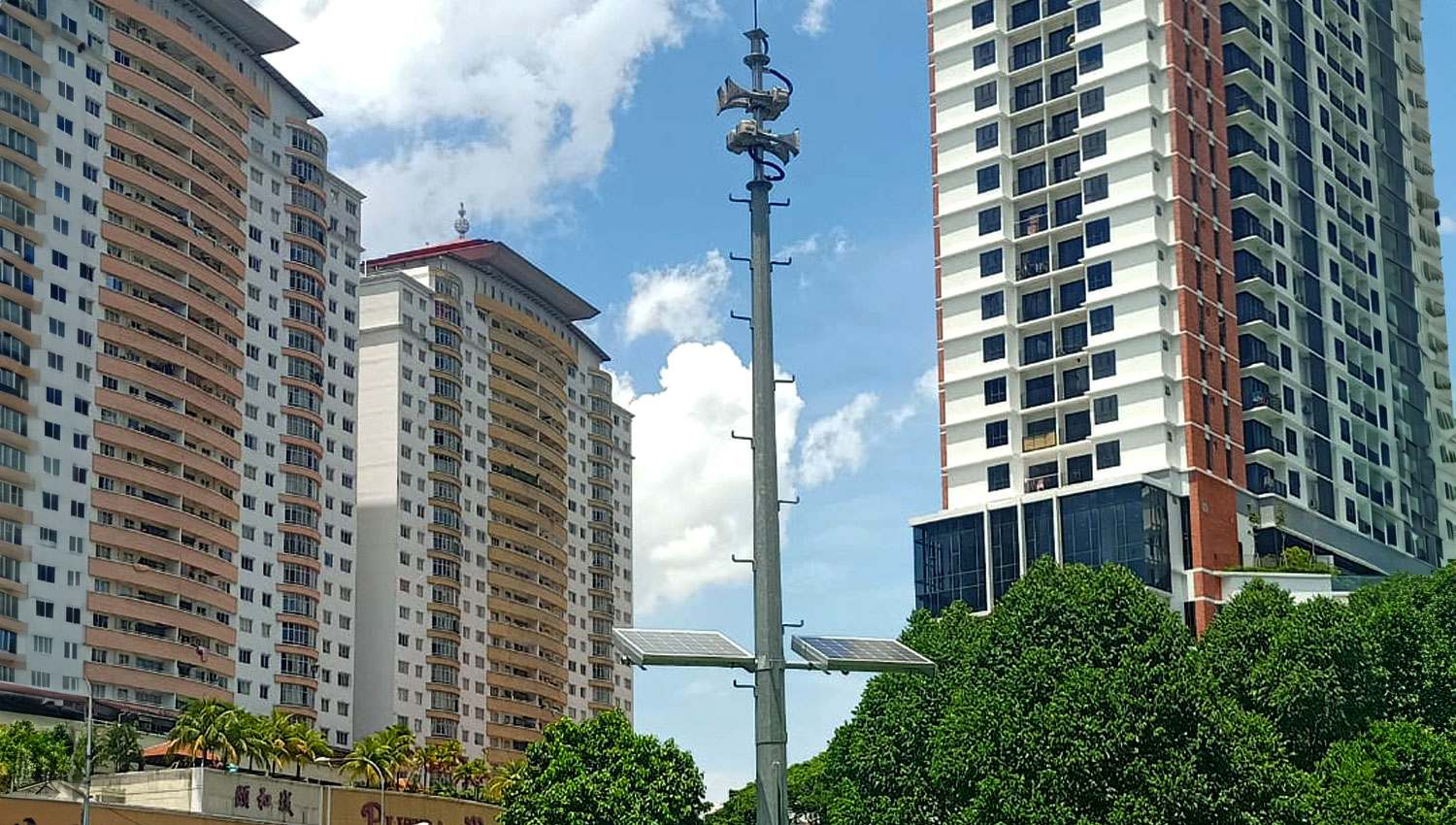
Our flood warning systems are already protecting communities in different parts of the world. In Kuala Lumpur, Malaysia, 33 electronic sirens are integrated with a forecasting and monitoring system and support autonomous alarm activation. In Yemen, PAVIAN sirens are connected to environmental sensors and centrally managed through our software VEKTRA®. These projects demonstrate how modern outdoor warning can connect monitoring, detection and public warning into one integrated system.
Our flood warning systems demonstrate how modern outdoor warning can connect monitoring, detection and public warning into one integrated system.

Read the full case study here
Read the full case study here
So, Why Do Sirens Still Matter?
Because technology has changed. Disasters haven’t.
Disasters can strike at night, when people are asleep. Power may be out. Phones may be dead, out of reach or simply unnoticed. Yet people still need one clear message: “This is serious. You need to act now.”
Sirens bring that warning directly, immediately capturing attention and prompting people to act.
They do not replace digital alerts, mobile notifications or other emergency communication channels. Modern sirens provide one critical layer in a resilient, multi-channel warning system.
From detection to warning. From warning to action. SOUND THAT SAVES LIVES.
Sources
[1] ABC News – Hard-hit Texas county had no flood warning sirens despite past discussions
[2] Kerr County, Texas – July 4 Ceremony at Memorial Cross Planned in Kerr County
[3] PEOPLE – Texas Community Where No One Died During Flooding Credits Sirens with Saving Lives

The article was written by
Dominika Pavlíková
Dominika is an international business manager responsible for the US and Canadian markets. She is a woman full of energy that she needs to invest into meaningful things. That’s how she fell in love with the mass notification industry. Dominika is also passionate about learning and continuous development. She loves people, books, art, history and new challenges, which makes her feel more alive.