

Listen to audio:
Europe is warming faster than the global average. Floods, heatwaves and extreme weather events are causing rising human and economic losses. EU policy is now shifting from reactive disaster response to proactive risk management. At the centre of this shift are effective early warning systems.
Climate Risks in Europe Are Increasing Rapidly
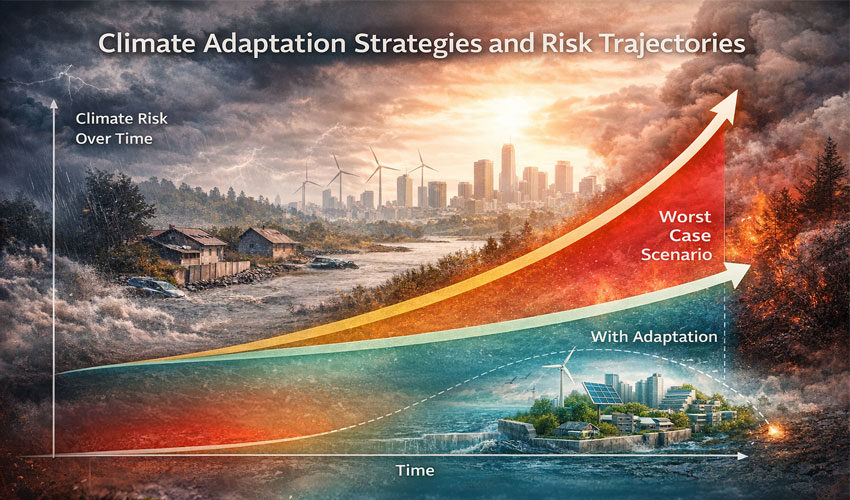
The Adaptation Report is clear: Europe’s escalating climate risks require a stronger, more proactive and coordinated approach to adaptation. Climate hazards are already generating average annual infrastructure damages of around EUR 45 billion, representing a five-fold increase compared to the 1980s. Without effective adaptation measures, risks are projected to reach critical levels by mid-century.
In this context, early warning systems for climate adaptation are no longer a supplementary tool. They are becoming a structural requirement for climate resilience across Europe.
From Disaster Response to Proactive Risk Management
EU policy is increasingly aligned with the principle of “anticipate and act.” This approach focuses on taking proactive measures before impacts materialise, in line with the precautionary principle.
The Adaptation Report highlights that improving early warning capabilities and stress-testing crisis management systems is a priority. Warning systems must enable timely and coordinated responses before risks escalate into disasters.
This shift is also reflected in international frameworks. Under the Sendai Framework for Disaster Risk Reduction, countries are required to strengthen risk assessment and enhance early warning systems. Similarly, the Paris Agreement includes targets related to adaptation, planning and early warning capabilities.
For public authorities and operators of critical infrastructure, this creates a clear obligation: systems must be in place to detect risks early and communicate warnings effectively.
How Early Warning Systems Reduce Climate Risks and Losses
Proactive adaptation, supported by effective early warning systems, significantly reduces damage once hazards occur. Flooding currently accounts for more than half of total losses from extreme weather events in Europe.
Studies show that adaptation measures:
- reduce mortality during heatwaves
- limit economic losses from floods
- improve response times during emergencies
The benefits of early action often outweigh the costs. Beyond reducing direct damage, early warning systems protect infrastructure, safeguard economic activity and reduce pressure on public crisis response budgets.
For decision-makers, investing in warning systems is not only a safety measure, but a cost-effective resilience strategy.
Why Critical Infrastructure Needs Early Warning Systems
Infrastructure decisions often create long-term dependencies that last decades. For this reason, critical infrastructure must be designed to withstand a wide range of future climate scenarios from the outset.
Delayed adaptation can lead to irreversible or catastrophic consequences.
At the same time, cascading and transboundary risks are increasing. Europe’s infrastructure systems are highly interconnected. A failure in one region can quickly propagate across borders through energy networks, transport systems or supply chains.
In this environment, early warning systems play a central operational role. They transform risk assessment into actionable response and support effective crisis management.
Key Requirements for Effective Early Warning Systems for Climate Adaptation
An effective early warning system must meet several critical conditions. In many high-risk environments, electronic sirens form the backbone of these systems by providing immediate and unmistakable acoustic alerts.
A robust system should:
- operate reliably under extreme conditions
- reach people in time, even in noisy industrial or urban environments
- integrate with crisis management systems and trigger coordinated response
- support monitoring, evaluation and continuous improvement
Electronic sirens remain one of the most reliable and universally understandable warning technologies. They operate independently of mobile networks, individual devices or language barriers.
In industrial zones, ports, energy facilities and densely populated urban areas, acoustic warning systems often represent the final and most critical layer of defence.
As EU policy continues to strengthen prevention and preparedness, requirements for tested and documented warning capabilities will increase. Early warning systems are rapidly moving from recommendation to expectation.
Benefits for Municipalities and Infrastructure Operators
For municipalities, investing in modern early warning systems improves compliance with EU resilience objectives and reduces long-term financial risks.
For operators of industrial sites and critical infrastructure, early warning systems help to:
- reduce operational and safety risks
- minimise liability exposure
- prevent business interruption
- improve emergency response coordination
A well-designed warning system enables response within minutes. It protects employees, nearby communities and physical assets, while demonstrating a proactive approach to risk management.
From Policy to Implementation: The Next Step
The direction of EU policy is clear. Climate adaptation must be proactive, forward-looking and integrated into planning processes. Early warning systems are recognised as a key component of resilience and preparedness strategies.
For organisations, the next step is practical implementation:
- translate risk assessments into technical solutions
- analyse warning coverage
- test system reliability and performance
Climate risks are intensifying, and preparedness can no longer remain theoretical.
Conclusion: Early Warning Systems as a Core Element of Climate Adaptation
Early warning systems for climate adaptation are becoming a critical component of resilience strategies across Europe. They enable faster response, reduce losses and help protect both people and critical infrastructure in an increasingly complex risk environment.
As climate risks continue to intensify, preparedness must move from strategy to implementation. For public authorities and infrastructure operators, this means ensuring that warning systems are reliable, scalable and fully integrated into emergency response processes.
If you are reviewing your climate resilience strategy or upgrading your emergency preparedness, now is the right time to assess whether your warning system is fit for purpose. Robust, field-proven electronic siren systems remain a key building block of effective early warning systems for climate adaptation.
Sources
- https://climate-advisory-board.europa.eu/reports-and-publications/strengthening-resilience-to-climate-change-recommendations-for-an-effective-eu-adaptation-policy-framework
- https://climate-advisory-board.europa.eu/news/escalating-climate-impacts-demand-urgent-coordinated-adaptation-across-the-eu
- https://climate-advisory-board.europa.eu/reports-and-publications/20260217_adaptation-report.pdf (PDF)

The article was written by
Róbert Jakab
Robert is like a moving photograph – because he is like a video. He can capture 60 frames per second. Whenever something happens, he records it. Currently, he’s working on smaller videos and hoping to make a feature film one day and then its sequel. Telegrafia 2: Monkey Power